RODIN DENTAL OFFICE

Periodontal surgery

Periodontal surgery — keeping your own teeth

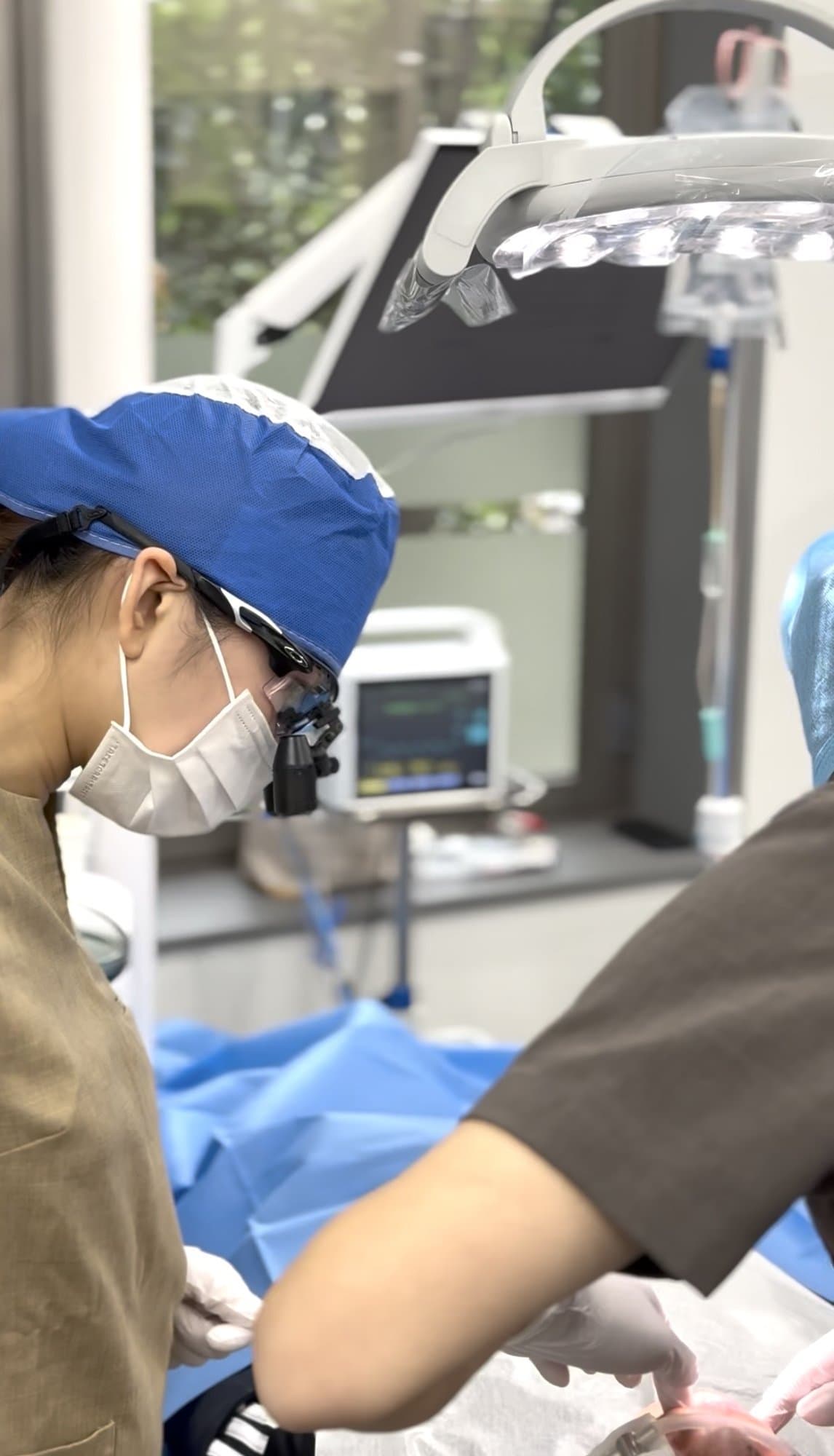
Gum and bone treatment led by Dr. Tsubasa Yoshizawa

When deep gum pockets, bone loss or receding gums remain after cleaning, periodontal surgery can help keep teeth that would otherwise be at risk. We start with a full examination, explain the options and costs in writing, and follow you with regular maintenance afterwards.

Consultations in English or Japanese. Self-pay treatment; Japanese National Health Insurance is not accepted.

Why it matters

Gum disease is common — and it rises with age

Periodontitis develops quietly: the gums can bleed little and hurt little while the bone around a tooth is lost. In Japan's national survey, the share of people with periodontal pockets of 4 mm or more grows with each age group.

  • 25–3432.7%
  • 35–4434.7%
  • 45–5443.7%
  • 55–6447.5%
  • 65–7456.2%
People with periodontal pockets of 4 mm or more, by age. Source: Ministry of Health, Labour and Welfare, Survey of Dental Diseases 2022 [1].
How treatment is planned

Surgery is one step in a staged plan

We follow the stepwise approach of the European Federation of Periodontology (EFP) clinical practice guideline [2]. Surgery is considered only for the areas that do not heal enough after cleaning.

  1. 01

    Foundations

    Examination with pocket charting and X-rays, home-care coaching, professional cleaning above the gum line, and attention to risk factors such as smoking and diabetes.

  2. 02

    Deep cleaning

    Scaling and root planing below the gum line, followed by a re-evaluation. The aim is no pockets deeper than 4 mm that bleed, and none of 6 mm or more.

  3. 03

    Surgery where pockets remain

    Pockets of 6 mm or deeper, or 5 mm pockets that still bleed, may need flap surgery. Where the bone loss forms a defect 3 mm deep or more, regenerative surgery can be considered.

  4. 04

    Supportive care

    Regular maintenance visits, at intervals of 3 to 12 months set by your risk, to keep the results stable.

Steps and thresholds from the EFP S3-level clinical practice guideline (Sanz et al., 2020) [2].

Treatments

What periodontal surgery can involve

Which procedure suits you depends on the depth and shape of the pockets, the bone around the tooth and the gum tissue. Each option is explained with its expected benefit, limits and cost before you decide.

Saving teeth

Flap surgery (access flap)

The gum is gently lifted so the root surfaces and the bone around them can be cleaned under direct vision, then the gum is stitched back in place.

It is used for deep pockets that remain after deep cleaning, where instruments cannot reach the base of the pocket from outside.

When it is considered
Residual pockets of 6 mm or more, or 5 mm pockets that bleed, after Step 2.
Cost
Quoted after examination

Saving teeth

Periodontal regenerative surgery

For bone loss that forms a vertical defect next to a tooth, regenerative surgery aims to rebuild part of the lost bone and attachment.

The EFP guideline recommends regenerative surgery for residual deep pockets with intrabony defects of 3 mm or more, using barrier membranes or enamel matrix derivative, with or without bone substitutes [2]. How much is regained varies from person to person.

When it is considered
Deep residual pockets with an intrabony defect of 3 mm or more.
Cost
Quoted after examination
EFP S3 guideline [2]

Bone regeneration

Bone regeneration (GBR) and ridge augmentation

After a tooth is lost or extracted, the jawbone shrinks. Guided bone regeneration (GBR) uses bone graft material and a membrane to rebuild bone where an implant is planned or where volume is lacking.

When a tooth is extracted, the socket can be grafted at the same visit. A systematic review found that ridge preservation reduces the loss of bone width and height compared with leaving the socket to heal on its own [4].

When it is considered
Before or with an implant when bone is thin, or at the time of an extraction.
Cost
GBR ¥249,900 · Extraction with ridge augmentation: front tooth ¥259,900, back tooth ¥299,900
Avila-Ortiz et al., 2019 [4]

Gum grafting

Connective tissue graft

For receding gums, a small piece of connective tissue, usually taken from the palate, is placed under the gum to cover exposed roots and thicken thin gum tissue.

A Cochrane review found that a connective tissue graft with a coronally advanced flap may give slightly better root coverage and more keratinised gum than some alternatives; the certainty of the evidence was low [3].

When it is considered
Gum recession with sensitivity, thin gums, or before orthodontic or restorative work.
Cost
Quoted after examination
Cochrane review, 2018 [3]

Gum shaping

Gingivectomy

Removes overgrown gum tissue to reduce false pockets that trap plaque, or to even out the gum line before a crown or veneer.

When it is considered
Gum overgrowth or uneven gum margins without bone loss.
Cost
¥29,900
Maintenance

Keeping the results: supportive periodontal care

Periodontitis can return. After active treatment, regular maintenance is what keeps pockets shallow and the bone stable.

The EFP guideline recommends supportive periodontal care at intervals of 3 to a maximum of 12 months, set according to each person's risk [2].

  • Check-ups

    Pocket charting and bleeding checks compared with your previous records, so changes are found early.

  • Professional cleaning

    Removal of plaque and tartar above and below the gum line (PMTC + Airflow).

  • Home care

    Coaching on brushing and interdental cleaning for the areas that need it most.

  • Risk factors

    Smoking and blood-sugar control affect healing and stability; we discuss them with you.

Tsubasa Yoshizawa
Your doctor

Dr. Tsubasa Yoshizawa

Oral Surgery & Periodontal Care

Dr. Yoshizawa leads oral surgery and periodontal care at Rodin. He examines, plans and performs the surgery, and works with the hygienists who look after your maintenance.

Background

  • Graduate of Tokyo Dental College
  • Visiting Lecturer, Tokyo Dental College
  • Residency — Oral and Maxillofacial Surgery, Nagoya University Hospital
  • Worked at a periodontal specialty practice in the United States
  • Residency in Periodontics, University of Pennsylvania (starting 2027)
Meet our team →
Fees

Fees

Scaling & root planing (per quadrant)¥39,900
Gingivectomy¥29,900
Guided bone regeneration (GBR)¥249,900
Extraction with ridge augmentation — front tooth¥259,900
Extraction with ridge augmentation — back tooth¥299,900
Maintenance cleaning (PMTC + Airflow)¥19,900
Flap surgeryQuoted after examination
Periodontal regenerative surgeryQuoted after examination
Connective tissue graftQuoted after examination

All prices in JPY, tax included. Self-pay treatment. Your plan and fees are explained in writing before treatment; IV sedation is available at an additional fee.

See the full fee schedule →
Risks

Risks and side effects

  • Swelling, pain and bruising for a few days after surgery.
  • Bleeding, and rarely infection, at the treated area or the palate donor site.
  • The gum line may recede after surgery, and teeth can feel more sensitive.
  • Grafts and regenerative treatment do not always achieve the planned amount of bone or gum; a further procedure may be needed.
  • Smoking, uncontrolled diabetes and irregular maintenance reduce the results.

Gums usually settle within a few weeks; bone and attachment changes are re-evaluated over several months. Results vary from person to person.

FAQ

Frequently asked questions

Do I need surgery for gum disease?

Not always. Many people improve with home care and deep cleaning. Surgery is considered only for areas where deep pockets remain after cleaning and re-evaluation.

Can lost bone grow back?

Sometimes, partly. Regenerative surgery can rebuild some bone in defects of a suitable shape, typically vertical defects 3 mm deep or more. How much is regained varies, and not every defect is suitable.

Is the surgery painful?

It is done under local anaesthesia. Discomfort and swelling for a few days afterwards are common and are managed with pain relief. IV sedation is available if you are anxious.

How long does recovery take?

Most people return to normal activities within a day or two. The gums usually settle over a few weeks; results are re-checked over several months.

Where does the gum graft come from?

Usually from the palate. The donor site heals on its own; it can feel sore for a while.

Why is bone needed before an implant?

An implant needs enough bone around it. When the bone is thin or low, bone regeneration (GBR) may be done before or at the same time as the implant.

How often do I need maintenance?

Every 3 to 12 months, depending on your risk. Most people start at shorter intervals after surgery.

Is it covered by insurance?

Rodin is a self-pay clinic and does not accept Japanese National Health Insurance. We issue itemised invoices and treatment certificates in English for overseas or private insurance claims.

Talk to us about your gums

Bring any X-rays or records you have. We will examine your gums and explain the options and costs in writing.

Featured In

  • Japan Living Guide — Featured dentist articleFeatured: English-speaking dentist in Tokyo
  • Tokyo American ClubMember Community Partner
Periodontal Surgery in Tokyo — Bone & Gum Grafts | Rodin Dental